We build the games AI needs to prove it can actually play.
World Engine reverse-engineers real, commercial games down to verified mechanics, then uses that knowledge to generate new ones: deterministic physics, telemetry-verified rules, playable at 60 fps. Every build is a real game, not a screenshot, and every claim we make about it is measured.
How it works
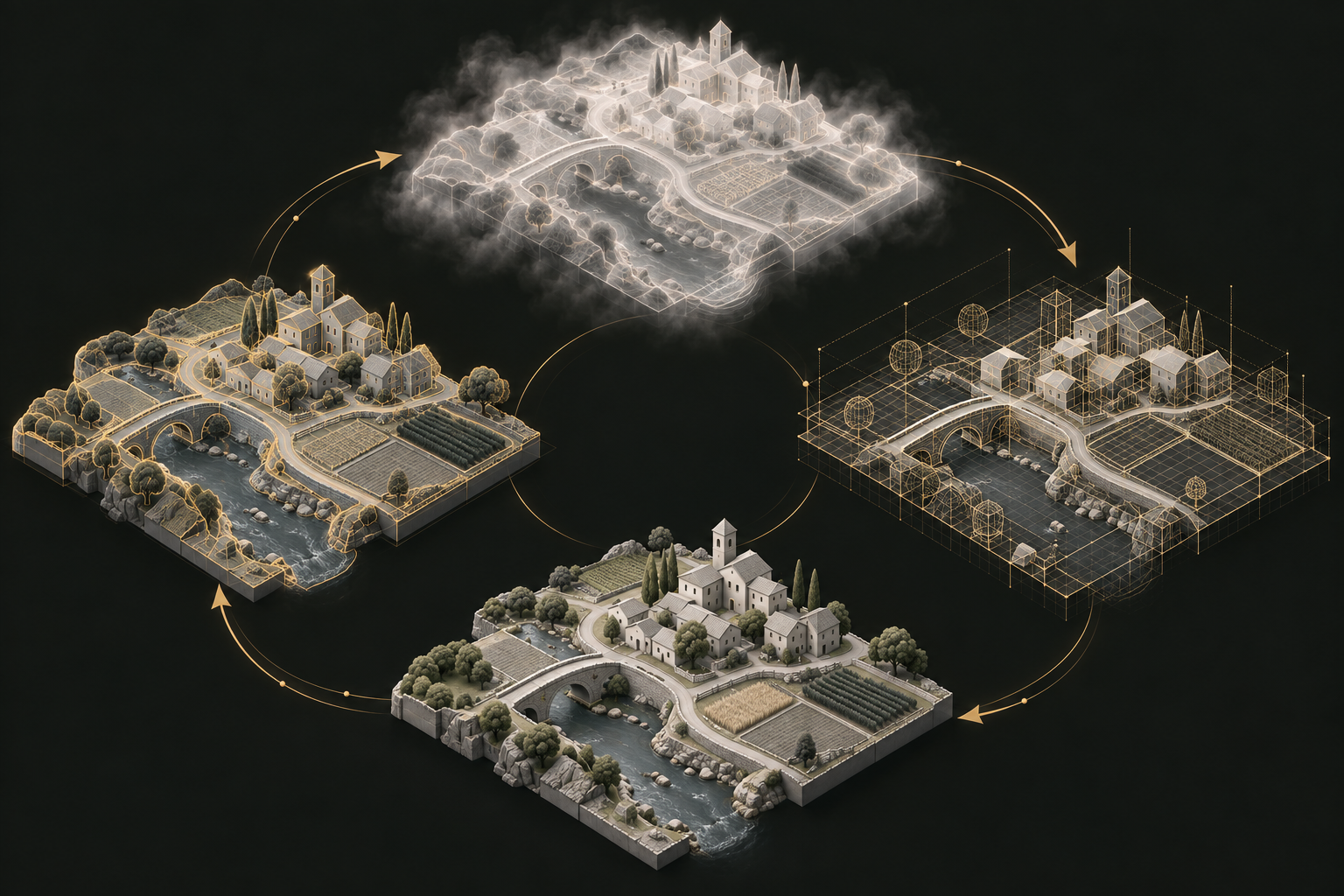
Three roles, run on repeat, until the build holds up.
A diffusion model designs the next version of the game: one new mechanic, one hardware era, a bolder look. A coding model builds it for real, with deterministic physics and telemetry-verified mechanics, at 60 fps or it doesn't ship. Judges and discriminators score the result and catch what's faking it: a similarity score that looks high but doesn't hold up as real gameplay. Then the loop runs again.
Custom evals, not synthetic benchmarks
Every eval we run is built from a real-world environment, reverse-engineered from a real game, not generated from a prompt. The corpus behind this system holds 23,560 of them.
Published work
From Diffusion Dreams to Playable Games is the formal writeup: target-faithful game implementation as constrained program search, run through four generative roles and measured across three studies on one deterministic engine. Submitted to IAAI‑27, Deployed Applications track. Currently under review.
Request the preprint →